
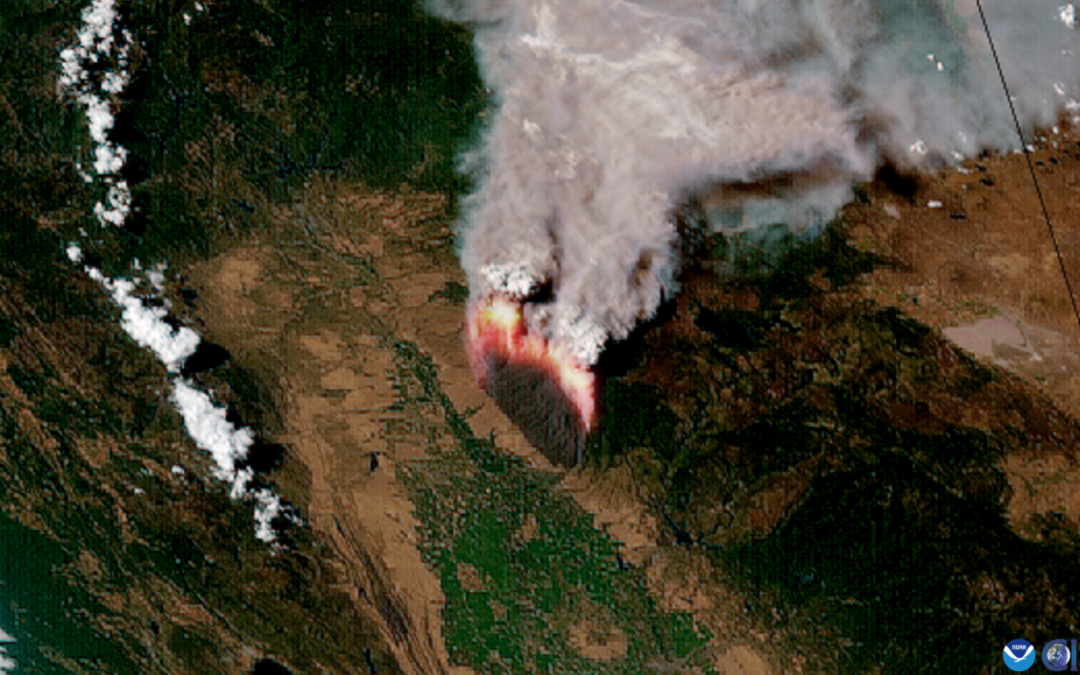
Wildfire Forensic Meteorologist Expert Witness for Attorneys
Certified meteorology expert witnesses deliver defensible testimony using methods commonly evaluated under Daubert standards
With my passion for weather since I can remember, I have always been fascinated by fires and how and why they form. My grandfather, who was a farmer, taught me early just how dangerous they can be. I remember growing up where he lived; it was legal to make fires in the yard and burn leaves. That has since changed. That was 40 years ago, but that’s how my intrigue began. On my grandfather’s farm. 40 years later, as a certified forensic meteorologist, I’ve learned just how complex this can be and why a forensic meteorologist is critical in situations like this.
When utility equipment sparks a wildfire that destroys homes and lives, weather conditions at the moment of ignition determine legal liability. This guide explains how certified forensic meteorologists reconstruct fire weather, establish causation, and provide expert testimony that withstands cross-examination.
Inside This Guide
01
Why Weather Reconstruction Determines Wildfire Liability
02
The Forensic Weather Reconstruction Process
03
Critical Weather Parameters in Utility Wildfire Cases
04
Regional Weather Patterns in Major Wildfire Zones
05
Data Sources and Chain of Custody Requirements
06
Expert Witness Qualifications and Testimony Standards
07
Practical Case Applications by Legal Theory
08
Frequently Asked Questions
09
Common Mistakes in Wildfire Weather Analysis
10
When to Engage an Expert Witness
Reading time: Approx. 12 minutes
| Parameter | Typical Values & Sources |
|---|---|
| Geographic Scope | CONUS-wide (Regional variations: California/Southwest, Pacific Northwest, Southeast) |
| Time Resolution | ±15-30 min ignition window accuracy (Local time + UTC correlation required) |
| Critical Wind Threshold | 25-35 mph sustained, 40-60 mph gusts (ASOS 1-min, 5-sec data, station-specific) |
| Humidity Metrics | RH <15-20%, VPD >40-50 hPa (AWOS/RAWS hourly observations) |
| Primary Data Sources | NOAA NCEI (ISD, LCD), NWS ASOS/AWOS, RAWS, SPC mesoanalysis, NFDRS fuel moisture |
| Typical Cost Range | $250-500/hr analysis, $350-600/hr testimony (15-40 hrs initial reconstruction) |
| Confidence Assessment | High: ≥2 independent ASOS + radar agreement; Medium: Single station + model; Low: Sparse/interpolated |
⚖️ Defensible Methodology for Wildfire Reconstruction
To ensure court-admissible results, our forensic reconstructions utilize:
1
High-Resolution Modeling
HRRR (High-Resolution Rapid Refresh) and NAM (North American Mesoscale) data for sub-kilometer atmospheric resolution.
2
Observational Verification
ASOS/AWOS station data and local METAR reports provide ground-truth validation of modeled conditions.
3
Verification Standards
All analyses adhere to AMS (American Meteorological Society) best practices for forensic reconstruction.
4
Opacity Standards
Smoke plume analysis conducted via EPA Method 9 certified protocols for visibility assessment.
✓ Daubert-Compliant | ✓ Peer-Reviewed Methods | ✓ Chain of Custody Documentation
Wildfire litigation hinges on answering one question: Could the utility have reasonably foreseen the fire danger under prevailing weather conditions? A forensic meteorologist expert witness provides the scientific foundation to answer this by reconstructing weather at the ignition location to ±15-30 minute accuracy using federally archived NOAA data.
Unlike fire investigators who focus on physical evidence at the scene, meteorology expert witnesses establish the atmospheric conditions that made ignition possible and spread inevitable. This weather context determines whether equipment failure under extreme wind represents negligence or an unforeseeable act of nature.
Why Weather Reconstruction Determines Wildfire Liability
Courts recognize that utilities cannot be held liable for every equipment failure—only those occurring under conditions where reasonable care demanded preventive action. Weather data establishes this foreseeability threshold through three legal mechanisms.
Establishing Duty of Care Through Red Flag Warnings
National Weather Service Red Flag Warnings represent official notice of extreme fire danger conditions. When utilities fail to de-energize lines or implement enhanced inspections during active Red Flag periods, this demonstrates knowledge of heightened risk. A certified meteorologist expert witness verifies warning issuance times, geographic coverage, and whether conditions at the ignition site met Red Flag criteria.
- National Weather Service Red Flag Warning criteria are established locally by each forecast office in coordination with fire agencies. Typical elements include thresholds for sustained wind and gusts (often 15-25+ mph), low relative humidity (commonly 15-25% or lower), and 10-hour fuel moisture (often in the single digits), applied over a specified duration (commonly 2-6 hours), but exact values vary by region
- Confirmation that 10-hour fuel moisture fell into the single digits (many operations treat around 8% or lower as indicative of critically dry fine dead fuels, though thresholds vary regionally)
- Evidence the utility received NWS warnings through emergency notification systems
Wind Speed Causation for Equipment Failure
Utility equipment design standards specify maximum wind loads before failure becomes probable. Expert meteorologist testimony establishes whether actual wind speeds at ignition time exceeded these engineering thresholds, proving equipment was subjected to forces beyond its rated capacity.
- ASOS 1-minute sustained wind averages and 5-second peak gust data from nearest stations
- Terrain-adjusted wind field modeling for complex topography (California mountains, Pacific Northwest gorges)
- Comparison to ASCE 7-22 design wind speeds and utility-specific equipment ratings
- Documentation of wind direction relative to line orientation and vegetation strike zones
Regional variation: California cases often involve offshore Santa Ana winds (40-70 mph gusts), while Pacific Northwest cases feature Cascade downslope east winds. Southeast cases typically involve lower wind thresholds but higher ambient fuel moisture requiring different fire spread modeling.
Drought Attribution and Climate Foreseeability
Long-term drought conditions can greatly increase ignition susceptibility and fire spread potential when an ignition source is present. Forensic meteorologists quantify drought severity using Palmer Drought Severity Index (PDSI) and Keetch-Byram Drought Index (KBDI) to demonstrate utilities operated equipment in documented extreme fire danger environments.
- PDSI values ≤-3.0 (severe drought) or ≤-4.0 (extreme drought) from NOAA NCEI Climate Divisional Database
- KBDI scores >600 (high fire danger) or >700 (extreme) from NFDRS archived data
- Multi-year precipitation deficits and live fuel moisture trends from RAWS networks
- Historical fire weather climatology showing conditions exceeded 95th-99th percentiles
The Forensic Weather Reconstruction Process
Court-admissible weather analysis requires systematic data collection, quality control, and uncertainty quantification. The following methodology ensures expert testimony withstands Daubert scrutiny and cross-examination.
A certified forensic meteorologist follows this five-step reconstruction protocol to deliver defensible courtroom testimony on wildfire weather conditions.
Step 1: Define the Ignition Window and Geographic Domain
Establish precise ignition time estimates using fire progression mapping, utility fault recorder data, 911 call timestamps, and satellite fire detection. Typical initial uncertainty: ±30-60 minutes, refined to ±15-30 minutes through convergent analysis.
- Request utility SCADA data showing circuit breaker trip times (UTC timestamps required)
- Obtain CAL FIRE or state forestry fire progression maps with georeferenced perimeters
- Analyze GOES-R series satellite fire detection products (for example from GOES-18 over the West and GOES-19 over the East), using the highest available scan cadence for the event (up to 1-2 minutes in mesoscale sectors), to identify first thermal detection
- Cross-reference emergency dispatch logs and eyewitness reports for ignition plume observations
Step 2: Retrieve and QC Primary Observational Data
Download archived surface observations from NOAA NCEI Integrated Surface Database (ISD) and Local Climatological Data (LCD) for all ASOS/AWOS/RAWS stations within 25 km of ignition. Apply quality control flags to identify erroneous readings.
- ASOS 1-minute and 5-minute data for peak wind gusts (not just hourly METAR)
- RAWS 10-minute observations for remote locations lacking ASOS coverage
- Quality flags: reject data with sensor malfunction codes, missing timestamps, or physically impossible values
- Document all stations: ID, lat/lon, elevation, distance/bearing from ignition, observation times UTC
Chain of custody documentation: Record NCEI retrieval timestamp, dataset version, and file hashes for discovery production. Courts require proof data was not altered post-incident.
Step 3: Terrain-Adjust Observations and Model Micro-Scale Winds
Raw station data may not represent conditions at the exact ignition location due to topographic effects. Apply physics-based downscaling when stations are >5 km away or elevation differs by >200 meters.
- WindNinja terrain wind model (USFS standard) for canyon/ridge wind acceleration zones
- Logarithmic wind profile adjustment for vegetation canopy roughness differences
- Adiabatic lapse rate corrections for humidity and temperature at different elevations
- Validation against any available mesonet or utility weather sensors near ignition site
Step 4: Calculate Fire Danger Indices and Fuel Moisture
Translate raw meteorology into fire behavior parameters using National Fire Danger Rating System (NFDRS) algorithms. These indices quantify ignition probability and rate of spread potential.
- 10-hour fuel moisture (small dead fuels: critical for initial spread)
- 1000-hour fuel moisture (large dead fuels: indicates deep drying from prolonged drought)
- Energy Release Component (ERC): total available heat per unit area
- Burning Index (BI): flame length and intensity under observed wind/humidity
Step 5: Quantify Uncertainty and Assign Confidence Levels
Expert testimony must honestly disclose measurement limitations and assumption sensitivity. Courts respect transparent uncertainty quantification more than false precision.
- High confidence: Multiple ASOS stations <10 km showing agreement within ±5 mph, ±10% RH
- Medium confidence: Single nearby station + model corroboration, or stations 10-25 km away
- Low confidence: Distant stations >25 km requiring heavy terrain adjustment or model-only estimates
- Report all values as ranges with ± uncertainty bounds, not point estimates
Critical Weather Parameters in Utility Wildfire Cases
Specific meteorological variables determine ignition probability and fire behavior. Expert witnesses must explain how each parameter contributed to the disaster.
Wind Speed: The Primary Equipment Stress Factor
Sustained winds ≥25 mph create sufficient aerodynamic load to cause conductor slap, broken insulators, or vegetation contact. Peak gusts ≥40 mph can snap crossarms or topple weakened poles. Forensic analysis must distinguish between sustained wind (1-minute average) and peak gusts (instantaneous maximum) because equipment failure modes respond differently to constant load versus shock loading.
ASOS data granularity: Standard hourly METAR reports include only 2-minute sustained wind averages. ASOS 1-minute datasets include 2-minute average sustained wind and 5-second peak gust data reported each minute from the nearest stations, providing far more detail than standard hourly METAR reports. In my experience, relying only on standard hourly METAR data and ignoring high-resolution gust information can materially weaken a wildfire case where equipment failure aligns with brief extreme gusts.
Vapor Pressure Deficit: The Invisible Ignition Accelerant
Vapor Pressure Deficit (VPD) quantifies atmospheric drying potential—the thermodynamic driving force pulling moisture from vegetation. VPD >40-50 hPa creates extreme fire danger even if relative humidity appears moderate.
VPD calculation: A common operational approximation for VPD is VPD ≈ (1 – RH/100) × 6.1078 × exp(17.27×T / (T+237.3)), where T is temperature in °C and RH is relative humidity in percent. Different fire-weather tools may use closely related formulations, but all capture the same physical concept of atmospheric drying power. This derived metric often reveals fire danger not obvious from RH alone.
Example: 75°F air at 25% RH yields VPD of roughly 22 hPa (moderate fire danger). At 90°F and 25% RH, VPD jumps to about 36 hPa (much more extreme drying potential) despite the identical relative humidity. Expert testimony must explain this nuance to juries.
Dead Fuel Moisture: The 10-Hour Timelag That Decides Spread Rate
The 10-hour timelag fuel moisture class represents small dead woody fuels roughly 0.25-1 inch in diameter, such as twigs and small branches, while very fine flashy fuels like grasses are more closely associated with the 1-hour fuel class. Forensic meteorologists calculate 10-hour fuel moisture from observed temperature and RH using NFDRS algorithms validated by USFS research. This converts raw weather into fire behavior language courts understand: “Fuels were as dry as kiln-dried lumber at the time of ignition.”
Regional Weather Patterns in Major Wildfire Zones
Wildfire weather varies dramatically across the United States. Expert witnesses must understand regional climatology to contextualize conditions within local norms.
California and Southwest: Santa Ana and Diablo Winds
- Offshore wind events with adiabatic warming and extreme drying (RH <10% common)
- Peak season: October through March when desert high pressure combines with California troughs
- Typical gust velocities: 40-70 mph in mountain passes, 50-90 mph in extreme events
- Critical fire weather thresholds: Sustained winds >25 mph, RH <15%, fuel moisture <8%
Pacific Northwest: East Wind Downslope Events
- Columbia Gorge and Cascade gap winds with 40-60 mph sustained velocities
- September East Wind events create annual peak fire danger despite wet climate
- Marine layer influence typically moderates fire weather except during blocking ridges
- Critical difference: Less extreme absolute dryness but severe wind-driven spread rates
Southeast: Frontal Passage and Drought-Driven Fires
- Pre-frontal southwest wind surge events with 30-45 mph gusts and rapid RH drops
- Peak fire season: February through May before summer monsoon establishes
- Higher ambient humidity (20-30% RH) still dangerous with adequate wind and drought
- Pine needle fuel beds and wiregrass create rapid surface fire spread despite moisture
Data Sources and Chain of Custody Requirements
Courts demand proof that weather data used in expert testimony is authentic, unaltered, and properly documented. Federal archives provide the gold standard.
NOAA NCEI: The Primary Weather Data Archive
National Centers for Environmental Information (NCEI) maintains the official U.S. climate archive. Data obtained from NCEI can qualify under the public-records hearsay exception in Federal Rule of Evidence 803(8), and its status as an official federal archive supports authentication under rules such as FRE 902(5), provided chain of custody and provenance are properly documented.
Critical datasets:
- Integrated Surface Database (ISD): Global hourly observations from ASOS/AWOS/METAR networks, includes quality flags
- Local Climatological Data (LCD): Detailed daily summaries for major airports, includes extremes and remarks
- Climate Divisional Database: Monthly PDSI and temperature/precipitation anomalies by climate division
- 1-Minute ASOS: High-resolution wind and pressure data archived by NCEI as a dedicated dataset; accessing it requires explicitly requesting the 1-minute archive rather than just downloading standard hourly METARs
RAWS and NFDRS: Wildland Fire-Specific Networks
Remote Automatic Weather Stations (RAWS) operated by USFS, BLM, and NPS provide observations in wildland areas lacking ASOS coverage. RAWS data feeds the National Fire Danger Rating System.
Advantages for litigation: RAWS stations often located on ridgetops and remote locations matching wildfire-prone areas. 10-minute observation frequency captures short-term wind variability missed by hourly ASOS.
Limitations: Less rigorous quality control than ASOS, occasional sensor drift, some stations report only during fire season. Always corroborate RAWS data with nearby ASOS when possible.
Documentation Standards for Discovery and Court
Expert reports must include complete data provenance to withstand opposing counsel challenge. Follow this documentation protocol:
- NCEI retrieval timestamp (UTC), order number if applicable, dataset version identifiers
- Station metadata: WMO ID, ICAO code, name, lat/lon, elevation MSL, distance/bearing from ignition
- Observation times in both local time (with timezone) and UTC (e.g., “1653 PDT (2353Z)”)
- Quality control procedures applied, any data rejected and why
- Model versions and input parameters for any derived quantities (VPD, fuel moisture, terrain adjustment)
Forensic Meteorologist Expert Witness Qualifications and Testimony Standards
Not all meteorologists qualify as expert witnesses for wildfire litigation. Courts require demonstrated expertise in fire weather and forensic analysis methodology.
Professional Certifications That Establish Credibility
American Meteorological Society (AMS) Certified Consulting Meteorologist (CCM): Requires professional experience, client references, and peer review. CCM designation signals expertise in forensic applications versus purely academic background.
National Weather Association (NWA) Seal of Approval: Broadcast and operational meteorology certification. Less common in litigation but demonstrates practical forecasting experience.
EPA CERTIFICATION METHODS 9 AND 22: This is a major bonus.
Specialized fire weather credentials: NWCG (National Wildfire Coordinating Group) certifications such as Fire Weather Forecaster (FWFO) or Incident Meteorologist (IMET) demonstrate direct wildfire experience.
Courtroom Experience Versus Academic Credentials
PhD meteorologists with impressive publication records may struggle under cross-examination if they lack litigation experience. Conversely, experienced forensic meteorologists without advanced degrees often provide more effective testimony because they communicate complex concepts in accessible language.
What courts value most: Demonstrated history of providing expert testimony that survived Daubert challenges, peer-reviewed publications on fire weather or forensic meteorology, and ability to explain VPD and fuel moisture to juries without jargon.
Daubert Standard for Scientific Testimony
Federal courts and most state courts apply the Daubert v. Merrell Dow Pharmaceuticals standard for expert testimony admissibility. Weather reconstruction methods are evaluated under the Daubert standard using factors such as:
- Testability: Methods can be tested and validated (NFDRS algorithms, terrain models have published validation studies)
- Peer review: Techniques published in refereed journals (Journal of Applied Meteorology, Fire Management Today)
- Error rate: Known accuracy bounds (±5 mph wind, ±10% RH from ASOS, higher uncertainty for modeled values)
- Standards and controls: Existence and maintenance of standards controlling the technique’s operation (NFDRS protocols, AMS best practices)
- General acceptance: Methods are standard practice in fire weather community (USFS operational use establishes this)
Practical Case Applications by Legal Theory
Weather expert testimony supports multiple liability theories depending on case facts and jurisdiction.
Negligence: Failure to Maintain Equipment Under Known Extreme Conditions
- Weather data proves utility knew or should have known equipment operated in Red Flag conditions
- Wind speeds exceeded design thresholds documented in utility engineering standards
- Prolonged drought created foreseeable fire danger requiring enhanced vegetation clearance
- Meteorologist documents that utilities operated equipment during documented extreme fire weather, providing factual inputs for attorneys and the court to evaluate any alleged breach of duty
Inverse Condemnation: California Public Utility Strict Liability
- Weather evidence establishes fire spread was rapid and catastrophic due to extreme conditions
- Forensic timeline links utility equipment failure to precise ignition moment via weather correlation
- Wind and fuel moisture data explains why fire could not be controlled despite prompt response
- Expert demonstrates even compliant equipment could fail under documented weather extremes
Climate Attribution: Long-Term Drought as Aggravating Factor
- Multi-year PDSI trend analysis can demonstrate unusually severe drought conditions that significantly elevate fire risk, supporting arguments that utilities needed to account for an evolving “new normal” in fire weather
- Historical climatology demonstrates conditions exceeded 99th percentile thresholds
- Live fuel moisture monitoring documented vegetation stress months before ignition
- Climate data establishes “new normal” fire weather requiring updated utility risk management
Frequently Asked Questions About Forensic Meteorology in Wildfire Cases
What weather data do forensic meteorologists analyze in wildfire cases?
We analyze surface wind speed and gusts from NOAA ASOS/AWOS stations, relative humidity and vapor pressure deficit readings, 10-hour and 1000-hour fuel moisture indices, drought severity metrics (PDSI, KBDI), and Red Flag Warning verification data. Every measurement is tied to specific station IDs and UTC timestamps for court admissibility.
How much does a meteorologist expert witness cost for wildfire litigation?
Certified forensic meteorologists typically charge $250-500 per hour for case analysis and $350-600 per hour for deposition or trial testimony. Expect 15-40 hours for initial weather reconstruction depending on case complexity and geographic scope. Total expert fees for a comprehensive wildfire case range from $8,000 to $25,000.
What makes weather conditions legally relevant in utility wildfire cases?
Weather determines whether utilities exercised reasonable care under prevailing conditions. Wind speeds exceeding equipment design thresholds, Red Flag Warnings indicating high fire danger, and documented extreme drought all establish foreseeability and duty of care standards. Courts recognize meteorological evidence as objective proof of what utilities knew or should have known about fire risk.
Can forensic meteorologists determine exact ignition time from weather data?
We reconstruct probable ignition windows to ±15-30 minute accuracy using convergent evidence from multiple ASOS stations, radar wind profilers, surface observations, and satellite fire detection. Confidence depends on station proximity and observation frequency. Ignition times are never exact but can be constrained sufficiently to correlate with utility fault events.
What credentials should a wildfire meteorology expert witness have?
Look for AMS Certified Consulting Meteorologist (CCM) or NWA Seal of Approval credentials, demonstrated courtroom testimony experience, peer-reviewed publications on fire weather, and familiarity with NWCG standards and utility vegetation management protocols. Prior work as USFS Incident Meteorologist or Fire Weather Forecaster adds valuable real-world fire behavior experience.
How do regional differences affect wildfire weather analysis?
California and Southwest cases emphasize Santa Ana and Diablo wind events with specific RH thresholds below 15%. Pacific Northwest cases focus on east wind downslope events through Cascade gaps. Southeast cases involve different fuel moisture regimes and typically higher ambient humidity requiring adjusted fire danger indices. Expert witnesses must understand regional climatology to properly contextualize conditions.
Common Mistakes in Wildfire Weather Analysis
Using only standard hourly METAR data and missing critical wind gusts: ASOS records 5-second and 1-minute peak gusts between hourly observations. Equipment failure often correlates with brief extreme gusts not captured in hourly averages. Requesting only METAR data means missing the smoking gun.
Failing to document data retrieval chain of custody: Opposing counsel will challenge whether data was altered or selectively chosen. Document NCEI retrieval timestamps, dataset versions, and provide complete raw data files in discovery. Courts have excluded expert testimony for inadequate data provenance.
Ignoring terrain effects on wind and moisture: Station observations 10-25 km from ignition require terrain adjustment. Blindly applying distant station readings without modeling canyon acceleration or ridge blocking creates impeachable errors. Always validate adjustments against any local sensors or vegetation damage patterns.
Overstating certainty without quantifying uncertainty: Expert witnesses who claim false precision lose credibility under cross-examination. State all measurements as ranges with ± bounds. Explain confidence levels honestly. Juries respect transparent limitations more than manufactured certainty.
When to Engage a Forensic Meteorology Expert Witness
Early expert involvement dramatically improves case outcomes. Weather evidence is time-sensitive—satellite imagery may not be archived indefinitely, and memories of real-time conditions fade. Engage a meteorologist expert witness within 30-60 days of a wildfire incident if litigation is anticipated.
ENGAGE WITH A FORENSIC WILDFIRE METEOROLOGIST EXPERT WITNESS
Critical early tasks only experts can perform: Requesting ASOS 1-minute data early is critical because many operational systems and aviation portals only expose limited recent history, even though NCEI maintains a permanent archive of 1-minute ASOS observations for forensic retrieval. Additional critical tasks include downloading high-resolution satellite fire progression data, documenting real-time Red Flag Warnings and fire weather forecasts before they are archived or deleted, and preserving any utility weather sensor or fault recorder data showing environmental conditions.
Weather reconstruction becomes significantly more difficult 6-12 months post-incident as some operational feeds are overwritten, access paths change, and relevant high-resolution datasets become harder to identify and retrieve, even though NCEI maintains long-term archives. Courts have sanctioned parties for failure to preserve weather evidence when experts could have secured it earlier.
Technical Appendix: Detailed Methodology and Data Sources
Surface Observation Networks
ASOS (Automated Surface Observing System): 900+ stations at airports nationwide. Observes temperature, dewpoint, wind (1-min sustained, 5-sec gusts), pressure, visibility, cloud height, precipitation. Quality controlled per NWS directives. Data latency: real-time to 24 hours for archive.
AWOS (Automated Weather Observing System): Approximately 650 stations across the continental U.S. at smaller airports and remote locations, operated by FAA, states, and local entities. Similar parameters to ASOS but often lacks precipitation. Quality control less rigorous. Some stations report only during airport operating hours.
RAWS (Remote Automatic Weather Stations): 2,200+ wildland fire weather stations operated by USFS, BLM, NPS, BIA. 10-minute observations including fuel moisture sticks and fuel temperature. Optimized for fire danger assessment rather than aviation. Some seasonal coverage only.
Derived Fire Weather Indices
10-hour Fuel Moisture: Equilibrium moisture content of dead fuels with ~10-hour lag time to atmospheric changes (small branches and twigs; fine fuels like grasses are typically represented by the 1-hour fuel class). Calculated from temperature and RH using NFDRS stick calibration curves. Many fire-weather operations treat single-digit 10-hour fuel moisture values (around 8% or lower) as indicative of critically dry fine dead fuels, but specific thresholds are set regionally based on local climatology, fuel models, and Predictive Service Area guidance.
1000-hour Fuel Moisture: Moisture in large dead logs representing seasonal drought accumulation. Calculated from 7-day and 30-day precipitation totals and temperature. Indicates deep drying requiring months to develop. Critical threshold: ≤12%.
Energy Release Component (ERC): Available energy per unit area in BTU/ft². Integrates fuel moisture across all size classes weighted by fuel loading. High values (>80-90th percentile for region) indicate extreme intensity potential.
Terrain Wind Modeling
WindNinja (USFS/Firelab): WindNinja is a terrain-aware wind model developed by the USFS Missoula Fire Sciences Laboratory. Its default solver uses variational methods to enforce conservation of mass and capture ridgetop speed-up and valley channeling, and an optional CFD solver based on Reynolds-Averaged Navier-Stokes (RANS) equations is available for cases where detailed momentum effects are important. Input: one or more station observations plus DEM. Output: gridded wind speed/direction at user-specified resolution. Validation studies show ±20-30% accuracy in mountainous terrain.
Logarithmic Wind Profile: Adjusts observed winds at standard 10m height to different elevations and surface roughness. Uses Prandtl mixing length theory: U(z) = (u*/k) × ln(z/z₀), where u* is friction velocity, k=0.4 is von Karman constant, z₀ is roughness length. Appropriate for flat terrain adjustments only.
Uncertainty Quantification Methods
Instrumental uncertainty: ASOS wind sensors are specified by NWS to measure wind with accuracy on the order of a few knots, with a starting threshold of about 2 knots, and the reported values reflect both sensor and processing characteristics. For forensic purposes, we typically treat ASOS wind speed uncertainty as a few mph in either direction and clearly disclose that range in expert reports. Temperature ±0.5°C, RH ±3% per NOAA Quality Management System directives.
Representativeness uncertainty: How well station observation represents conditions at ignition site. Function of distance, terrain roughness, and atmospheric stability. Conservative approach: ±20% for wind, ±10% for RH when station >10km away.
Model uncertainty: WindNinja validation studies show RMSE of 25-35% in complex terrain. Report modeled winds as ranges spanning ±30% unless validation data available. Fuel moisture model uncertainty ±2-3% absolute from stick calibration studies.
Chain of Custody Documentation Example
Weather Data Provenance Statement:
- Dataset: NOAA NCEI Integrated Surface Database (ISD) v1.0
- Retrieval timestamp: 2025-11-20 14:32:17 UTC
- Order number: NCEI-ISD-2025-11-1234567
- Stations: KOAK (Oakland Airport, 724930), KMCC (McClellan Field, 724839), KSAC (Sacramento Exec, 724835)
- Time period: 2024-10-08 00:00 UTC through 2024-10-09 23:59 UTC
- Parameters: Temperature, dewpoint, wind speed/direction, pressure, visibility, precipitation
- Quality control: NCEI automated QC flags applied, manual review for missing/suspect values
- File hash (SHA-256): a3f5d8c2e9b1… (complete hash available in technical appendix)
- Analysis tools: Python 3.11.5, NumPy 1.24.3, Pandas 2.0.3, MetPy 1.5.1, WindNinja 3.10.2
- Uncertainty: ±2 mph wind speed (instrumental), ±3% RH (instrumental), ±20% terrain adjustment (model)
This documentation enables opposing experts to replicate analysis and verify results. Courts require this level of transparency for admissibility under Daubert.
Need Expert Weather Analysis for Your Wildfire Case?
Contact me for a free case review and cost estimate.
John Bryant – AMS Certified Forensic Meteorologist
Forensic Meteorology Resources
Federal Weather Data Archives:
- NOAA NCEI Integrated Surface Database (ISD)
- National Centers for Environmental Information
- National Weather Service
Wildland Fire Weather Resources:
- National Wildfire Coordinating Group (NWCG)
- Wildland Fire Assessment System (WFAS)
- Remote Automatic Weather Stations (RAWS)
- NWS Fire Weather Program
Professional Organizations:
The author is a certified forensic meteorologist, not an attorney. This content is educational regarding forensic meteorology services. For legal advice, consult a qualified attorney in your jurisdiction.
About the author.
John Bryant is a distinguished forensic meteorologist with 30+ years of specialized experience in weather analysis and reconstruction, as well as expert witness testimony. He holds the rare global distinction of triple certification by the American Meteorological Society (AMS), the National Weather Association (NWA), and the Environmental Protection Agency (EPA). He is recognized as one of the few meteorologists worldwide to hold all three certifications concurrently, a credential that underscores his unmatched expertise in forensic weather reconstruction and regulatory compliance.
Mr. Bryant provides authoritative expert testimony and forensic weather reconstruction for high-stakes litigation on behalf of both defense and plaintiff. He has created meteorological reports used to support legal arguments at deposition and trial, and he has served as a pivotal expert in wrongful death and personal injury cases on both sides, where his foundational meteorological analysis shaped legal strategies and case outcomes. His expert report in a two-million-dollar case involving extreme weather conditions resulted in a favorable settlement for the client.
He consults closely with legal teams to translate complex atmospheric data into clear, accessible narratives that help judges and juries understand how weather conditions affected specific facts in a case. His ability to communicate technical weather science in plain language is central to the value he brings to litigation support.
Mr. Bryant holds a B.S. in Geosciences with an emphasis in Meteorology and Atmospheric Science from Mississippi State University. He previously served as Chief Meteorologist at an ABC affiliate station in Memphis for over a decade, where he directed a professional meteorological team and worked with regional emergency management services during severe weather events, including hurricanes, tornadoes, and winter storms. He has also collaborated with a NOAA team to audit and refine AI-driven weather models, conducting rigorous assessments of predictive technologies for weather sensitive sectors.