
Los Angeles Fires: Meteorological Analysis for Litigation
By John Bryant – Triple Certified AMS, NWA, EPA
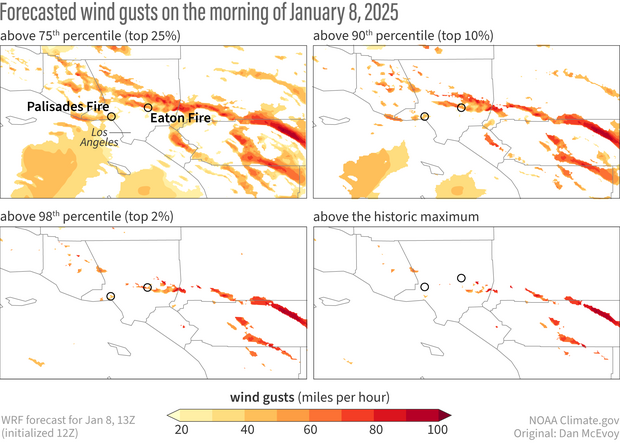
Original Image Courtesy: Dan McEvoy
The Palisades and Eaton Fire events of January 7-8, 2025 occurred during an exceptional Santa Ana wind episode with extreme offshore flow conditions. As litigation develops, attorneys will require detailed meteorological reconstruction to establish the atmospheric facts at specific times and locations.
My role as a forensic meteorologist is to reconstruct what the atmospheric conditions were, specifically wind speed, direction, humidity, pressure patterns, and atmospheric stability, at the time and place relevant to ignition and fire spread. I do not determine fire causation, equipment failure, or legal negligence. Those conclusions remain with counsel, fire investigators, and engineering experts.
ENGAGE WITH A FORENSIC WILDFIRE METEOROLOGIST EXPERT WITNESS
So much of the credit of this post goes to and is inspired by Reference: Li, F., Zhang, X., Cochrane, M., Kondragunta, S., & An, S. (2026). Fire Spread, Intensity, and Emissions Observations by Multiple Satellites: The Southern California Wildfires of January 2025. AGU Advances, 7, e2025AV002064. https://doi.org/10.1029/2025AV002064
The Atmospheric Context: What the Science Shows
Satellite observations analyzed in the peer-reviewed literature reveal the exceptional nature of the January 2025 event:
Documented Atmospheric Conditions:
- Surface Wind Velocities: Sustained speeds of 40-80 km/hr (25-50 mph) with gusts documented at 110-144 km/hr (68-90 mph) at elevated weather stations during the critical burn period
- Relative Humidity: Critically low levels (≤20%) persisting from morning on January 7 through early morning January 8
- Atmospheric Dryness: Vapor Pressure Deficit (VPD) conditions indicating severe fuel moisture depletion
- Pressure Gradient: A strong high-pressure system (>1040 mb) over the Great Basin driving powerful offshore flow
- Temperature Anomaly: Nighttime temperatures 2.7-4.2°C warmer than the preceding night, maintaining low fuel moisture during nocturnal hours
Critical Meteorological Questions for Litigation
Each case involving the Palisades or Eaton Fires will require answers to specific atmospheric reconstruction questions:
Wind Conditions at Ignition and Spread:
- What were observed wind speeds and peak gusts at the nearest ASOS/AWOS stations during the ignition window?
- How do 1-minute high-resolution observations compare to standard hourly METAR reports?
- What does topographic wind modeling indicate about microscale wind acceleration at the specific ignition location?
- How did vertical wind shear between surface (2m) and elevated (10m) observations affect mixing and turbulence?
Atmospheric Dryness and Fuel Conditioning:
- What were the Vapor Pressure Deficit values during the critical period?
- How long had vegetation been exposed to desiccating offshore flow prior to ignition?
- What was the precipitation deficit in the weeks and months preceding the event?
- Did elevated nighttime temperatures maintain abnormally low fuel moisture during traditionally cooler hours?
Foreseeability and Warning Timeline:
- What was the synoptic pressure pattern (Great Basin high pressure system intensity and gradient strength) in the 24-48 hours prior to ignition?
- When did the National Weather Service issue Red Flag Warnings for the affected areas?
- What was the forecast wind speed versus the observed conditions at relevant locations?
- How did forecast models perform in predicting the intensity and duration of the offshore wind event?
PSPS Decision Analysis:
- Did atmospheric conditions meet or exceed utility-established thresholds for Public Safety Power Shutoffs?
- What were forecast versus observed wind conditions at the circuit locations relevant to ignition?
- Does the meteorological data establish that extreme fire weather conditions were foreseeable based on the pressure gradient and atmospheric setup?
The 75% Rule: Implications for Litigation Timeline
Satellite fire progression analysis documented that both the Palisades and Eaton Fires burned approximately 75-80% of their final area within the first 24 hours after ignition, with residential areas experiencing rapid fire spread during this period. Maximum fire spread rates reached 1.0-3.7 km/hr under the extreme wind conditions.
This temporal concentration has significant implications for litigation. The meteorological conditions during this initial 24-hour window are the primary focus for reconstruction, as this period encompasses:
- Rapid fire spread affecting residential areas occurred during this initial 24-hour window
- Peak wind velocities and lowest humidity values
- The period when PSPS decisions and Red Flag Warnings would have been most critical
- The timeframe when atmospheric foreseeability is most directly testable
Data Sources for Atmospheric Reconstruction
Answering case-specific questions requires comprehensive analysis of multiple atmospheric data sources:
- ASOS/AWOS Stations: High-resolution (1-minute) wind observations from KLAX, KVNY, KBUR, and other regional airports
- RAWS Network: Remote Automated Weather Stations including Malibu Hills and Henninger Flats positioned for fire weather monitoring
- ERA5 Reanalysis: 0.25-degree hourly atmospheric fields for wind, temperature, humidity, and pressure
- Synoptic Pressure Observations: Surface pressure data from Great Basin stations to reconstruct the offshore flow gradient
- Satellite Observations: VIIRS and GOES-18 fire detection data documenting temporal fire progression
- NWS Archives: Red Flag Warnings, Fire Weather Watches, and forecast discussion products
- Topographic Wind Modeling: WindNinja or similar tools to downscale regional observations to site-specific conditions accounting for terrain effects
My Role in Your Case
I provide case-specific atmospheric reconstruction using observational data, validated reanalysis products, and peer-reviewed modeling techniques. My analysis establishes the meteorological facts, specifically wind conditions, atmospheric moisture, pressure patterns, and fuel dryness indicators, at the time and location relevant to your case.
I do not determine fire causation, ignition source, equipment failure, or legal negligence. Those determinations remain with counsel, fire origin and cause investigators, electrical engineers, and other expert disciplines. My expertise is confined to reconstructing the state of the atmosphere during the relevant timeframe.
My methodology is designed to rely on archived observations, established reanalysis products, and reproducible analytical techniques consistent with the reliability principles California courts apply to expert testimony in inverse condemnation and utility liability litigation.
About John Bryant
John Bryant is a distinguished forensic meteorologist with 30+ years of specialized experience in weather analysis and reconstruction, as well as expert witness testimony. He holds the rare global distinction of triple certification by the American Meteorological Society (AMS), the National Weather Association (NWA), and the Environmental Protection Agency (EPA). He is recognized as one of the few meteorologists worldwide to hold all three certifications concurrently, a credential that underscores his unmatched expertise in forensic weather reconstruction and regulatory compliance.
Mr. Bryant provides authoritative expert testimony and forensic weather reconstruction for high-stakes litigation on behalf of both defense and plaintiff. He has created meteorological reports used to support legal arguments at deposition and trial, and he has served as a pivotal expert in wrongful death and personal injury cases on both sides, where his foundational meteorological analysis shaped legal strategies and case outcomes. His expert report in a two-million-dollar case involving extreme weather conditions resulted in a favorable settlement for the client.
He consults closely with legal teams to translate complex atmospheric data into clear, accessible narratives that help judges and juries understand how weather conditions affected specific facts in a case. His ability to communicate technical weather science in plain language is central to the value he brings to litigation support.
Mr. Bryant holds a B.S. in Geosciences with an emphasis in Meteorology and Atmospheric Science from Mississippi State University. He previously served as Chief Meteorologist at an ABC affiliate station in Memphis for over a decade, where he directed a professional meteorological team and worked with regional emergency management services during severe weather events, including hurricanes, tornadoes, and winter storms. He has also collaborated with a NOAA team to audit and refine AI-driven weather models, conducting rigorous assessments of predictive technologies for weather sensitive sectors.
Reference: Li, F., Zhang, X., Cochrane, M., Kondragunta, S., & An, S. (2026). Fire Spread, Intensity, and Emissions Observations by Multiple Satellites: The Southern California Wildfires of January 2025. AGU Advances, 7, e2025AV002064. https://doi.org/10.1029/2025AV002064