
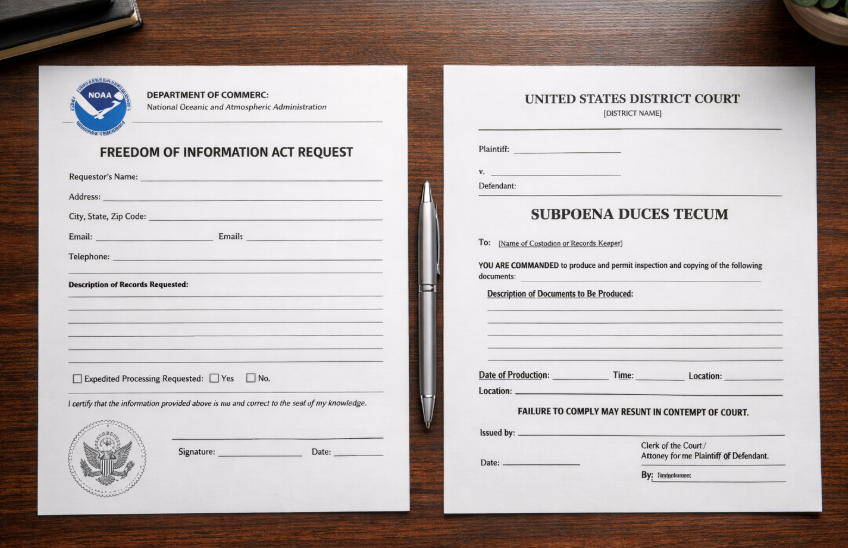
FOIA vs. Subpoena for Weather Data: Attorney’s Guide to Data Requests
Last Updated: February 4, 2026 — Verified against current FOIA regulations and case law
It has been my experience over the past year that accurate, certifiable weather data is increasingly difficult to find and more expensive. I hope this guide can help. I am a meteorology expert witness, and not an attorney, so double check this for the most current information.
Attorneys building slip-and-fall, premises liability, or insurance claims need weather data fast. The legal mechanism you choose (Freedom of Information Act request or subpoena) determines your timeline, costs, and whether records are court-ready.
This guide explains which tool works for which data source, how long each takes, and when you need certified records versus raw data. It includes agency-specific procedures and downloadable request templates.
Quick Reference: FOIA vs. Subpoena
| Factor | FOIA Request | Subpoena |
|---|---|---|
| Target Entities | NOAA/NCEI, NWS, FAA, federal agencies only | Private weather stations, airports, utilities, TV stations |
| Timeline | 20 business days (+10 extension) per 5 U.S.C. § 552(a)(6)(A)(i) | State-specific (5-30 days depending on jurisdiction) |
| Cost | Commercial use (attorneys): full costs, no free pages. Educational/news media: first 100 pages free, $0.10-0.25/page after. Digital data often free. | $20-75 duplication + witness fees if testimony required |
| Certification | $180-840+ (minimum $180 for 1-40 pages); generally court-admissible | Custodian must certify; may require live testimony |
Understanding FOIA for Weather Data
The Freedom of Information Act (5 U.S.C. § 552) mandates that federal agencies disclose records unless they fall under nine statutory exemptions. Weather observation data is almost never exempt because it’s factual, operational data without privacy or national security concerns.
FOIA Fee Categories: What Attorneys Need to Know
FOIA fees vary dramatically by requester category. Most attorneys requesting weather data for litigation fall into the “commercial use” category, which has the highest fees.
FOIA Fee Categories (15 CFR § 4.11 for Department of Commerce/NOAA; 5 U.S.C. § 552(a)(4)(A)(ii) for statutory authority):
- Commercial use requesters (attorneys seeking records for litigation): Charged for search, review, and duplication. No free pages. Full direct costs apply.
- Educational/news media requesters: First 100 pages free, duplication only after that. No search or review fees.
- All other requesters: First 2 hours of search free, first 100 pages of duplication free.
Key point: Agencies define “commercial use” as requests “for a use or purpose that furthers commercial, trade, or profit interests, which can include furthering those interests through litigation.” If you’re an attorney building a case, expect to be classified as commercial use.
NOAA National Centers for Environmental Information (NCEI)
What they have: The official archive for all U.S. weather observations. Includes ASOS/AWOS automated stations, cooperative observer (COOP) networks, radar (NEXRAD Level II and III), satellite imagery, and historical climate summaries.
FOIA contact: [email protected] or submit at www.ncei.noaa.gov
Response time: Simple station reports: 5-7 days. Multi-station reconstructions: 15-20 days. Complex radar analysis: full 20-30 days.
National Weather Service (NWS)
What they have: Real-time observations, forecast discussions, severe weather warnings, hydrometeorological reports. Less useful for historical reconstruction (those go to NCEI after 90 days) but critical if you need forecaster notes or warning decision rationale.
FOIA contact: [email protected]
Response time: 10-20 days.
Federal Aviation Administration (FAA)
What they have: Aviation weather observations (METAR reports from airport ASOS/AWOS systems), pilot reports (PIREPs), and terminal area forecasts. Essential for cases involving airports or flight operations.
FOIA contact: [email protected]
Response time: 20-30 days.
Limitation: FAA’s real-time weather data tools typically provide 30-45 days of access; historical aviation weather data (METAR, ASOS) is archived at NCEI and remains permanently available.
How to File a FOIA Request for Weather Data
Step 1: Identify the Correct Agency
Determine which agency holds the data you need. For most historical weather data (anything older than 90 days), go to NCEI. For real-time observations or forecaster notes, NWS. For airport weather, either FAA or NCEI.
Step 2: Draft Your Request Letter
Your FOIA request must be in writing (email is acceptable). Include:
- Clear subject line: “FOIA Request for Weather Data”
- Specific date range (with time zones if sub-daily data needed)
- Exact station identifiers (e.g., “ASOS station KMEM, Memphis International Airport”)
- Data products needed (e.g., “hourly METAR observations, NEXRAD Level II radar”)
- Request for certified copies if the records will be used in court
- Your contact information and preferred delivery format (email, mail, CD-ROM)
Step 3: Submit and Track
Email your request to the agency’s FOIA office. Most agencies auto-reply with a tracking number. The 20-day clock starts when they receive your request.
Step 4: Respond to Fee Estimates
If costs will exceed $25, the agency must send you a fee estimate and wait for your approval before processing. Review carefully. For attorneys (commercial use requesters), expect to pay full duplication costs with no free pages. Certification adds $180 minimum.
Step 5: Appeal if Denied
If your request is denied or unreasonably delayed, you have the right to appeal within 90 days per agency regulations implementing the FOIA Improvement Act of 2016. Send your appeal to the agency’s FOIA Appeals Officer (contact info is in the denial letter).
When to Use Subpoenas for Weather Data
FOIA only works for federal agencies. If you need weather data from private entities, you must use a subpoena.
Common Private Weather Data Sources
- Airport authorities (if not federal): Many regional airports operate their own weather stations independent of FAA/ASOS systems.
- Utility companies: Electric utilities often maintain weather stations to forecast load and track storm damage.
- Television stations: Local TV stations run proprietary weather sensor networks and radar.
- Private weather services: Companies like Weather Underground, DTN, and WeatherBug operate thousands of stations.
- Agricultural cooperatives: Farm co-ops and irrigation districts often run weather monitoring networks.
How to Subpoena Weather Records
Federal Rules (Fed. R. Civ. P. 45):
- Issue subpoena duces tecum commanding production of records
- Serve as the entity’s registered agent or custodian of records
- Entity must serve written objections within 14 days; production is due by the date specified in the subpoena
- Entity can charge reasonable costs for duplication and may require witness fees if custodian testimony is needed
State rules: Vary by jurisdiction but generally follow similar timelines (5-30 days). Check your state’s civil procedure rules for specific requirements.
Cost Comparison: FOIA vs. Subpoena
| Cost Item | FOIA (NCEI) | Subpoena (Private) |
|---|---|---|
| Filing/Service | $0 (no filing fee) | $50-150 (process server + court fees) |
| Document Production | Commercial use (attorneys): $0.10-0.25/page for all pages. Educational/news media: first 100 pages free, then $0.10-0.25/page. | $20-75 (reasonable duplication costs) |
| Digital Data | Usually free (CSV, NetCDF downloads) | Varies; some entities charge media costs |
| Certification | $180-840+ depending on page count (minimum $180 for 1-40 pages: $168 + $12 shipping) | $0-100 for affidavit; $200-500+ if live testimony required |
| Typical Total | $200-900+ (certification $180-840; digital data often free but attorneys pay full duplication costs) | $300-800 (higher if custodian testimony needed) |
Bottom line: FOIA certification costs $180-840+ for attorneys. Digital data may be free, but attorneys (commercial use requesters) pay full duplication costs. Subpoenas cost more but give access to localized private stations that may show conditions NOAA stations missed.
Certification and Court Admissibility
Raw weather data is not automatically admissible. You need certified copies with proper chain of custody documentation.
FOIA-Obtained Records
NOAA/NCEI provides certified copies that satisfy Fed. R. Evid. 902(4) (self-authenticating public documents). The certification includes:
- Official seal or stamp from the agency
- Signed statement from the custodian of records
- Declaration that records are true and complete copies
- Statement of the custodian’s authority to certify
Cost: NCEI charges $180 minimum (covers 1-40 pages: $168 base + $12 shipping). Additional pages cost approximately $4 per page. Large datasets (100+ pages) can exceed $840.
Subpoenaed Records
Private entities can provide certified copies, but you may need the custodian to testify if opposing counsel challenges authenticity. Include language in your subpoena requiring:
- Certification that records are true and complete
- Statement of how records are kept in the ordinary course of business
- Custodian’s contact information for potential deposition
Common Mistakes to Avoid
Vague requests: “All weather data for Memphis on January 15” is too broad. Specify station identifiers, exact time windows (with time zones), and the data products you need (e.g., “Hourly METAR from KMEM, 0000Z to 2359Z on 2025-01-15”).
Wrong agency: Historical data (older than 90 days) lives at NCEI, not NWS. Sending your FOIA to the wrong office adds 10-20 days while they forward it.
Forgetting certification: Always request certified copies in your initial FOIA letter. Requesting certification after you receive uncertified data requires a new request and resets the 20-day clock.
Ignoring private stations: NOAA stations can be 10-50 miles from your incident location. Private weather stations (airports, utilities, TV stations) may have been much closer. Use both FOIA and subpoenas strategically.
Frequently Asked Questions
How long does a FOIA weather data request take?
Federal agencies must respond within 20 business days per 5 U.S.C. § 552(a)(6)(A)(i). They can extend 10 more days with written notice. NOAA/NCEI often responds in 5-7 days for simple requests (single station, short time period); complex multi-station reconstructions may take the full 20-30 days.
When should I use a subpoena instead of FOIA for weather data?
Use subpoenas for private entities that FOIA doesn’t cover: airport operators not under FAA control, utility companies, television stations, and private weather networks. Also use subpoenas when you need certified custodian testimony because opposing counsel will challenge the foundation. FOIA only works for federal agencies like NOAA, NWS, and FAA.
How much does weather data cost from NOAA vs subpoena?
NCEI charges attorneys (commercial use requesters) for all duplication costs with no free pages. Uncertified digital data may be free. Certified copies cost $180 minimum (1-40 pages: $168 + $12 shipping) up to $840+ for larger datasets. Subpoenaed private entities can charge reasonable duplication costs (typically $20-75 per request) plus custodian witness fees ($200-500 or more) if live testimony is required at deposition or trial.
What is the difference between FOIA and a subpoena for weather records?
FOIA (5 U.S.C. § 552) compels federal agencies like NOAA, NWS, and FAA to disclose records within 20 business days. Subpoenas (Fed. R. Civ. P. 45 or state equivalents) compel private entities like weather stations, airports, and utilities to produce records. FOIA is free or low-cost for digital data but certification costs $180-840+. Subpoenas cost more upfront but can secure custodian testimony.
Are FOIA weather records admissible in court?
Yes, when properly certified. NOAA/NCEI provides certified copies with official seals and custodian affidavits that satisfy Fed. R. Evid. 902(4) for self-authenticating public records. Certification costs $180 minimum (1-40 pages) up to $840+ for larger datasets. Most courts accept certified NOAA records without requiring live testimony, though you should verify local jurisdiction requirements.
Can I FOIA weather data from private weather stations?
No. FOIA only applies to federal agencies. Private weather stations, commercial weather services, TV station weather equipment, and utility company sensors are not subject to FOIA. You must use a subpoena (Fed. R. Civ. P. 45 or state equivalent) to compel production from private entities. The subpoena timeline and costs vary by jurisdiction but typically require 5-30 days for compliance.
Summary and Action Steps
Key Takeaways:
- Use FOIA (5 U.S.C. § 552) for federal weather data from NOAA/NCEI, NWS, and FAA (20-day response timeline)
- Attorneys (commercial use): certification costs $180-840+, no free pages
- Use subpoenas for private weather stations (airports, utilities, TV stations) and when you need custodian testimony
- Always request certified copies suitable for court in your initial FOIA letter or subpoena
- Be specific: list station identifiers, precise time windows (with UTC), and exact data products needed
Additional Resources
- FOIA.gov: Official FOIA portal with agency contacts
- NCEI Data Access: NOAA’s climate data archive
- NWS FOIA: National Weather Service FOIA procedures
Need help navigating FOIA procedures or retrieving certified weather data? Contact us for professional data retrieval services.
Need Weather Data for Your Legal Case?
Expert FOIA request filing, subpoena coordination, and certified weather data retrieval
John Bryant – Forensic Meteorologist
Forensic Meteorology Resources
Weather Data & Research:
- National Oceanic and Atmospheric Administration (NOAA)
- National Weather Service
- National Centers for Environmental Information
Professional Organizations:
The author of this article is not an attorney. This content is meant as a resource for understanding forensic meteorology and weather data retrieval procedures. For legal matters, contact a qualified attorney.
Hello,
I am seeking to purchase evidence that provides specific photos (residential pictures of weather event happenings in a specific location), radar readings, precipitation readings etc.
Questions:
1. I am representing myself as a Pro Se Plaintiff in court. I need certified/expert testimony weather reports for trial. Are the fees the same for non-Attorneys?
2. Is it possible to provide pictures of a specific residence during inclement weather?
3. How much is a testimony witness for a case?
4. When do I need to provide a court date and to whom once the court date is established? How much notice do you need ?
5. If I am filing through the clerk (subpoena) what method of payment is accepted (cashier’s check) who should it be made out to?
6. What would be the rate for a 40 page evidentiary packet with duplicates and should addresses to each recipient be given to you for forwarding?
Thank you,
Temika Hearn