 All Posts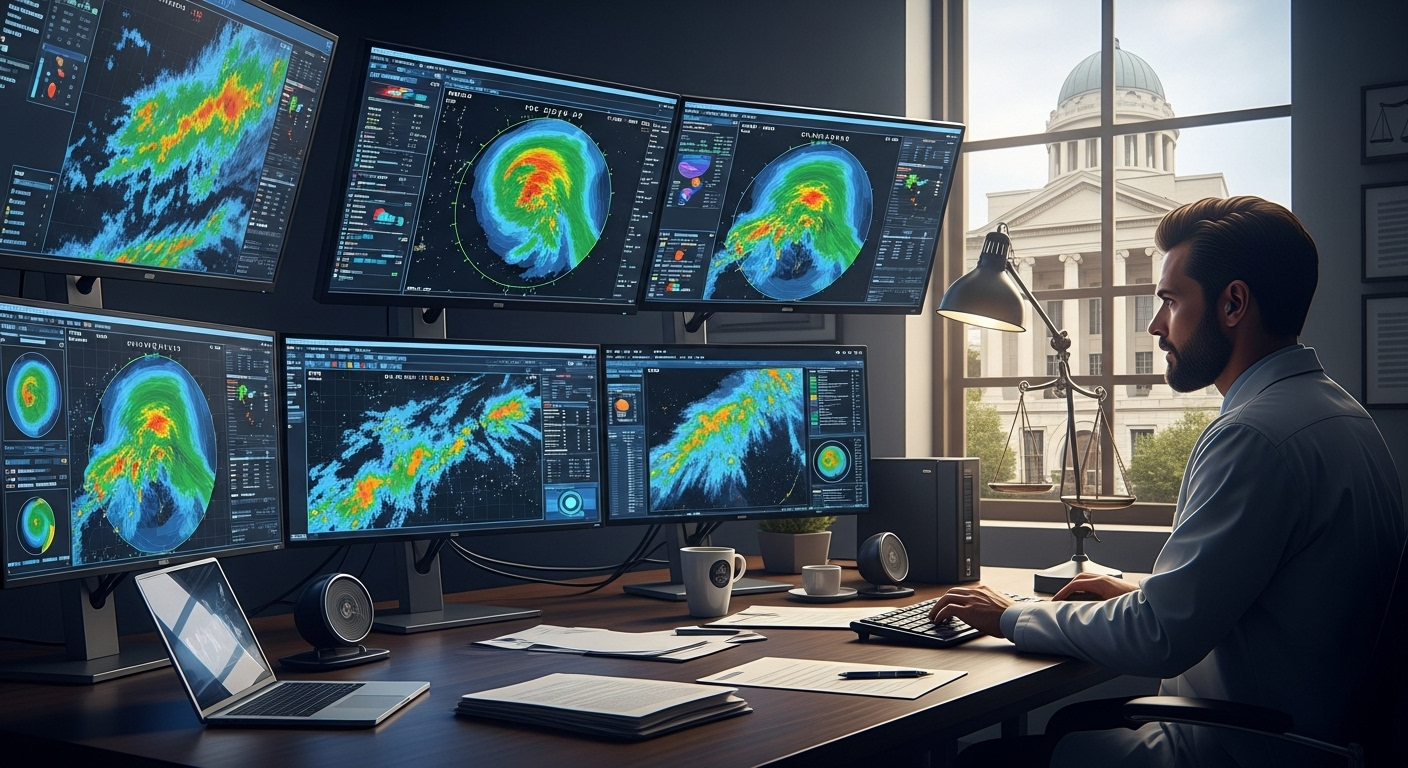


Forensic Meteorologist: How Weather Evidence Shapes Legal Outcomes
Key Takeaways
- Forensic meteorology transforms weather data into legally admissible evidence by reconstructing past atmospheric conditions.
- It relies on multiple verified data sources, including radar, satellite imagery, and weather stations, to ensure accuracy.
- Localized weather variations can significantly impact legal outcomes, making precise, location-specific analysis essential.
- Common applications include transportation accidents, insurance disputes, and workplace safety investigations.
- Scientific rigor and cross-verification distinguish forensic meteorology from general weather reporting.
- Expert witnesses must translate complex atmospheric data into clear, courtroom-ready insights.
- Early consultation helps preserve critical data and strengthens legal cases involving weather-related factors.
- Modern tools improve accuracy, but expertise remains crucial, especially when analyzing historical or limited data.
When weather becomes evidence: How atmospheric scientists help solve legal mysteries across America
A fatal car crash occurs on I-95 in Florida during what witnesses call “sudden fog.” An insurance company in California disputes whether lightning caused a house fire. A construction worker falls in Chicago during what his employer claims were safe wind conditions.
The answer isn’t in witness testimony. It’s written in the atmosphere.
You can find an expert forensic meteorologist for your case HERE
What Is Forensic Meteorology?
Forensic meteorology applies atmospheric science to legal cases. Think of it as CSI for weather.
We reconstruct past weather conditions using scientific methods and available data, aiming for the greatest possible accuracy. We don’t forecast what might happen. We determine what actually happened.
This matters in courtrooms from New York to Texas, from Washington to Georgia. When weather plays a role in accidents, injuries, or property damage, someone needs to know the truth.
Relevant Statistics: The Rising Impact of Weather in Legal Cases
Recent data shows that weather-related events are happening more often and causing greater financial damage, making them a key factor in many legal disputes and insurance claims.
- According to Climate Central, 23 billion-dollar weather disasters occurred in the U.S. in 2025, causing $115 billion in damages and 276 fatalities.
- According to Climate Central, 14 major weather events in just the first half of 2025 caused over $100 billion in losses, making it one of the most expensive periods on record.
- According to Gallagher Re, 55 billion-dollar weather disasters were recorded globally in 2025, highlighting the scale and global nature of climate-driven losses.
- According to Munich Re, natural disasters caused $131 billion in global losses in the first half of 2025 alone, significantly exceeding long-term averages.
These statistics show a clear pattern. Weather events are becoming more frequent, more expensive, and more contested.
For legal and insurance cases, this makes the role of a forensic meteorologist increasingly critical. By converting large-scale climate data into precise, case-specific analysis, they help establish facts, validate claims, and bring scientific clarity into complex disputes.
How Weather Becomes Courtroom Evidence
The Detective Work Begins
Forensic meteorologists for weather-related claims function as atmospheric detectives. We piece together what happened using hard data, not guesses.
- Historical weather station data from nearby locations
- Radar imagery showing precipitation and storm movements
- Satellite observations revealing cloud cover and atmospheric conditions
- Surface observations including temperature, humidity, and pressure
- Upper-air data showing wind patterns and atmospheric stability
Every measurement is documented and time-stamped. Conclusions are verified using all available sources. Where multiple independent sources are available, they are cross-checked for consistency.
Why Local Conditions Matter
Weather isn’t uniform. A valley in Oregon might have dense fog while hills two miles away are clear. Urban heat islands in Phoenix affect wind patterns differently than surrounding desert. Bodies of water create localized humidity changes along coastlines from Maine to Louisiana.
This matters in court. What happened at a specific intersection during a specific 10-minute window might be completely different from conditions just blocks away.
Real Cases Where Weather Takes the Stand
Forensic meteorology plays a vital role in many legal cases across the country, especially when weather conditions are disputed or complex. Here’s where atmospheric evidence makes the difference:
Transportation Accidents Coast to Coast
Aviation incidents from Atlanta to Seattle require expert analysis. Was turbulence predictable? Did wind shear contribute to a crash? Were visibility conditions accurately reported to pilots?
- Highway accidents in winter conditions across Minnesota, Montana, and the Dakotas
- Fog-related crashes on interstates from Virginia to California
- Ice formation analysis for accidents in Colorado, Wyoming, and New England
- Sudden weather changes are affecting commercial trucking nationwide
Insurance Claims and Property Damage
Insurance companies nationwide employ forensic meteorologists to verify weather-related damage claims. The questions are always the same:
- Did hail actually occur at the claimed location and time in Kansas, Oklahoma, or Nebraska?
- Was wind speed sufficient to cause structural damage in Florida, Louisiana, or the Carolinas?
- Could lightning have caused electrical damage at the precise moment claimed in Arizona, New Mexico, or Nevada?
The burden of proof is high. We must demonstrate that severe weather occurred with sufficient intensity at the exact location and time to cause the claimed damage.
Construction and Workplace Safety
Construction accidents from Texas to Pennsylvania often hinge on weather conditions. Were dangerous wind conditions foreseeable? Should work have been suspended based on available forecasts?
- Crane accidents during high wind events in major cities
- Roofing injuries during sudden storm developments
- Lightning strikes affecting outdoor workers nationwide
- Heat-related workplace injuries in Southern and Southwestern states
Regional Weather Risks That Commonly Lead to Legal Cases
Weather-related legal disputes often follow clear regional patterns. Understanding these patterns helps explain why certain types of cases are more common in specific parts of the country.
- Hurricane-prone regions (Florida and the Gulf Coast)
High winds, storm surge, and flooding frequently lead to property damage claims, insurance disputes, and construction liability cases. Determining wind speed thresholds and timing of impact is often critical. - Snow and ice in northern states
Slip-and-fall incidents, vehicle accidents, and workplace injuries are common in regions with prolonged winter conditions. Cases often depend on whether conditions were foreseeable and properly managed. - Wildfire and extreme heat conditions in California and the West
Dry weather, high winds, and heat create conditions for wildfires and infrastructure stress. Legal cases often involve liability for fire spread, utility failures, or unsafe working conditions.
These regional trends highlight how weather risks are not random. They follow predictable geographic patterns, making forensic meteorology essential in evaluating claims tied to local climate behavior.
How Forensic Meteorology Supports Insurance Fraud Detection
Insurance claims often rely on whether a weather event actually occurred and whether it was severe enough to cause the reported damage. Forensic meteorology plays a critical role in verifying these claims with objective, data-backed analysis.
Detecting false weather claims
By analyzing radar, satellite data, and ground observations, forensic meteorologists can confirm whether a reported event, such as hail damage, high winds, or lightning actually occurred at the claimed location and time. If no such event is recorded, the claim may be flagged as invalid.
Verifying exaggerated or misattributed damage
Even when a weather event did occur, the intensity matters. Forensic analysis helps determine whether wind speeds, rainfall, or other conditions were strong enough to cause the level of damage being claimed, or if other factors may be responsible.
Supporting claim validation or denial
Insurers use forensic findings to make informed decisions. Verified weather data can support legitimate claims, while inconsistencies between reported damage and actual conditions may lead to denial or further investigation.
This process ensures that claims are evaluated fairly, based on scientific evidence rather than assumptions or incomplete information.
The Science Behind the Investigation
Forensic meteorology isn’t opinion. It’s science.
Multiple Data Sources
We rely on verified sources maintained by the National Weather Service, NOAA, and other agencies. Each source has strengths and limitations:
Surface weather stations provide detailed local measurements but may not represent conditions across an entire area.
Weather radar offers excellent spatial coverage for precipitation but limited surface information.
Satellite data provides broad atmospheric context but lacks precision for specific locations.
Quality Control Is Everything
Every piece of weather data undergoes rigorous quality control. We account for instrument calibration errors, data transmission problems, and measurement coverage gaps.
This scientific rigor distinguishes forensic meteorology from casual observation. Our methodology must withstand cross-examination by opposing experts in courtrooms from Miami to Portland.
Differences Between Forensic Meteorology and Weather Forecasting
Understanding the difference between weather forecasting and forensic meteorology is essential, especially in legal and insurance contexts. While both rely on atmospheric science, they serve entirely different purposes. Forecasting focuses on predicting what might happen, often adjusting as new data emerges. Forensic meteorology, on the other hand, looks backward, using verified data to determine exactly what occurred at a specific place and time. This distinction becomes critical when accuracy and evidence matter most.
| Aspect | Weather Forecasting | Forensic Meteorology |
| Purpose | Predicts future weather conditions | Reconstructs past weather events |
| Approach | Uses models, probabilities, and projections | Uses verified, time-stamped data and scientific analysis |
| Data Sources | Forecast models and simulations | Radar data, satellite imagery, surface observations |
| Nature of Output | Predictive and subject to change | Factual and evidence-based |
| Reliability Over Time | Can change as conditions evolve | Fixed, based on confirmed historical data |
| Use Case | Public guidance and planning | Legal cases, insurance claims, investigations |
| Legal Admissibility | Not admissible as evidence (based on predictions) | Admissible as evidence (based on verified data) |
| Role in Court | Limited or none | Provides objective, defensible conclusions under cross-examination |
Legal Admissibility and Limits of Weather Evidence
Forensic meteorology is only valuable in court if the evidence meets strict legal and scientific standards. Courts rely on verified data from trusted sources such as government weather agencies, and expert analysis must follow established methodologies that can withstand cross-examination.
Not all weather data carries equal weight. Radar, satellite imagery, and surface stations each have limitations. Radar can show precipitation but not exact ground-level wind conditions. Weather stations provide accurate readings but may not reflect conditions at the exact incident location. Because of this, forensic meteorologists interpret multiple data sources together to form reliable conclusions.
Forecasts, by contrast, are not considered evidence. They are predictions that may change and cannot prove what actually occurred. Only reconstructed, time-stamped data supported by scientific validation is admissible in legal proceedings.
The Expert Witness Process
Checklist: What Information Clients Should Provide
To conduct an accurate forensic weather analysis, the quality of input matters as much as the data itself. Providing clear and complete information allows a forensic meteorologist to reconstruct conditions with greater precision and confidence.
- Exact time and location
The precise date, time, and location of the incident are critical. Even small differences in timing or distance can lead to very different weather conditions. - Photos and videos
Visual evidence helps validate conditions such as visibility, precipitation, road surface, or storm intensity at the scene. - Incident reports
Police reports, insurance claims, or workplace records provide context and timelines that support the analysis. - Witness statements
Firsthand accounts can offer useful details, especially when cross-referenced with scientific data.
Providing these details early helps streamline the investigation and strengthens the reliability of the final findings.
What Happens When You Hire a Forensic Meteorologist
- Incident verification: We confirm the exact location, date, and time
- Data collection: We gather all available atmospheric data from relevant sources
- Scientific analysis: We reconstruct conditions using proven meteorological principles
- Report preparation: We document our methodology and findings in clear language
- Testimony: If needed, we explain our conclusions in deposition or trial
Courtroom Challenges
Testifying requires translating complex atmospheric science into language that judges and juries understand. The challenge is the same whether in federal court in Illinois or state court in Alabama.
- We explain atmospheric concepts without oversimplifying the science
- We address uncertainty honestly and clearly
- We prepare for cross-examination about data gaps and limitations
Modern Technology vs. Historical Cases
Today’s forensic meteorologists have unprecedented access to atmospheric data. Doppler radar networks blanket the United States. Lightning detection systems pinpoint electrical activity with remarkable precision. Automated weather stations generate continuous measurements at thousands of locations from Alaska to Hawaii.
But many legal cases involve incidents from decades past. Weather monitoring was far more limited in the 1980s and 1990s. We often work with sparse data, using scientific principles to reconstruct conditions between distant observation points.
This is where expertise matters. Understanding atmospheric physics allows us to fill gaps responsibly while acknowledging limitations.
Frequently Asked Questions About Forensic Meteorology
What is forensic meteorology?
Forensic meteorology applies atmospheric science to legal proceedings. It reconstructs past weather conditions with scientific precision to determine what actually happened during an incident. Unlike forecasting, forensic meteorology analyzes historical data to provide definitive statements about atmospheric conditions at specific times and locations.
What does a forensic meteorologist do?
A forensic meteorologist analyzes past weather conditions for legal and insurance cases. They study data like radar, satellite images, and historical weather reports to determine what the weather was like at a specific time and place. Their findings help explain events such as accidents, property damage, or personal injury claims, and they often serve as expert witnesses in court.
How do forensic meteorologists reconstruct past weather conditions?
We analyze historical weather station data, radar imagery, satellite observations, surface measurements, and upper-air data. We synthesize information from multiple sources to create an accurate picture. Every measurement is documented, time-stamped, and verified through independent sources maintained by federal agencies.
What types of legal cases require forensic meteorology?
Transportation accidents (aviation and highway crashes), insurance claims for property damage, construction accidents, workplace safety cases, and criminal investigations all benefit from forensic meteorological analysis. Any case where weather conditions may have contributed to an incident or damage requires expert examination.
How accurate is forensic meteorological analysis?
Professional forensic meteorologists provide analysis with appropriate confidence levels based on available data. Modern weather monitoring networks provide unprecedented detail. We acknowledge uncertainty while providing scientifically rigorous conclusions that withstand cross-examination in courts nationwide.
What qualifications should a forensic meteorologist have?
Look for advanced degrees in atmospheric science or meteorology. Certification from organizations like the American Meteorological Society is essential. Training in legal procedures and expert witness testimony matters. Experience testifying in federal and state courts across the United States is critical.
How much does a forensic meteorologist cost?
Costs vary based on case complexity, data analysis requirements, and whether trial testimony is needed. Many experts offer free initial consultations to assess your case. Contact a qualified forensic meteorologist for a specific quote based on your legal needs.
Common Mistakes That Weaken Weather-Related Cases
Waiting too long to retain an expert: Weather data can become harder to obtain as time passes. Some automated systems overwrite data after months or years. Contact a forensic meteorologist when the weather becomes relevant to your case.
Relying on memory or general weather reports: Witness recollections are unreliable. General weather forecasts don’t capture conditions at specific locations and times. Only scientific analysis of actual data holds up in court.
Hiring unqualified “weather experts”: Not all meteorologists have forensic training or courtroom experience. Choose someone with proven expertise in legal proceedings and expert witness testimony.
When to Consult a Forensic Meteorologist
If weather played any role in an accident, injury, or property damage, consult a forensic meteorologist early. We serve attorneys, insurance companies, and legal teams across all 50 states.
Early consultation helps preserve evidence and build stronger cases. We can advise whether weather analysis will support or weaken your position before you invest heavily in litigation.
Forensic meteorology provides the scientific foundation for just outcomes, from slip-and-fall cases in New York to billion-dollar storm damage claims in Texas.
Expert Resources and Contact Information
- National Oceanic and Atmospheric Administration (NOAA): Primary source for U.S. weather data
- National Weather Service: Official forecasts and warnings nationwide
- American Meteorological Society: Professional certification and standards
- National Weather Association: Professional development for meteorologists
- SEAK Experts: Forensic meteorology expert witness directory
Ready to discuss your case?
Check out Weather and Climate Consulting Services HERE
John Bryant, AMS Certified Forensic Meteorologist
Weather and Climate Expert Consulting LLC
Phone: 901.283.3099
Email: [email protected]
Free case review and consultation
The author of this article is not an attorney. This article provides information about meteorology services for legal cases. For legal advice, consult a qualified attorney in your jurisdiction.